37 The Decoding Threshold
Wang et al. (2019) proposed the “Decoding Threshold Hypothesis” which posits that students below a certain proficiency level in single word reading will experience stagnant comprehension growth as they struggle with basic word recognition. More generally, nearly every aspect of middle school and high school depends on basic literacy skills. Thus we might expect to see evidence for a “Decoding Threshold” for skills beyond comprehension per se. For example Figure 36.3 reveals a Decoding Threshold for performance on a high-stakes summative assessment (see Section 36.2.3).
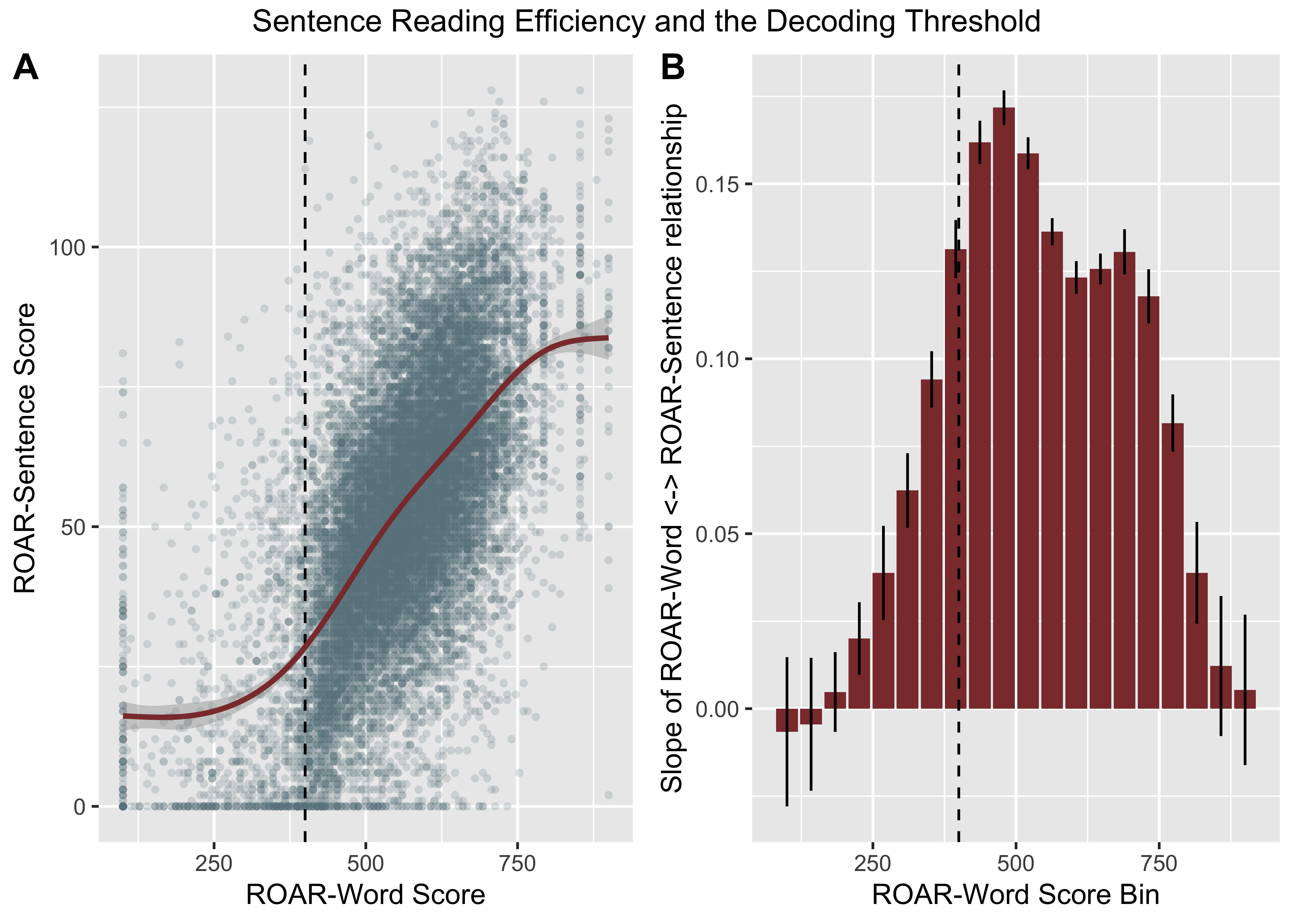
The Decoding Threshold can also be appreciated by examining the relationship between ROAR-Word and ROAR-Sentence in middle school and high school students. Based on 19272 observations from 11346 middle school and high school students, we fit a generalized additive model (GAM) to visualize the relationship between ROAR-Word and ROAR-Sentence. Figure 37.1 shows the pattern predicted by the Decoding Threshold Hypothesis: A steep relationship between single word reading and sentence reading efficiency above a certain threshold of word reading skills.
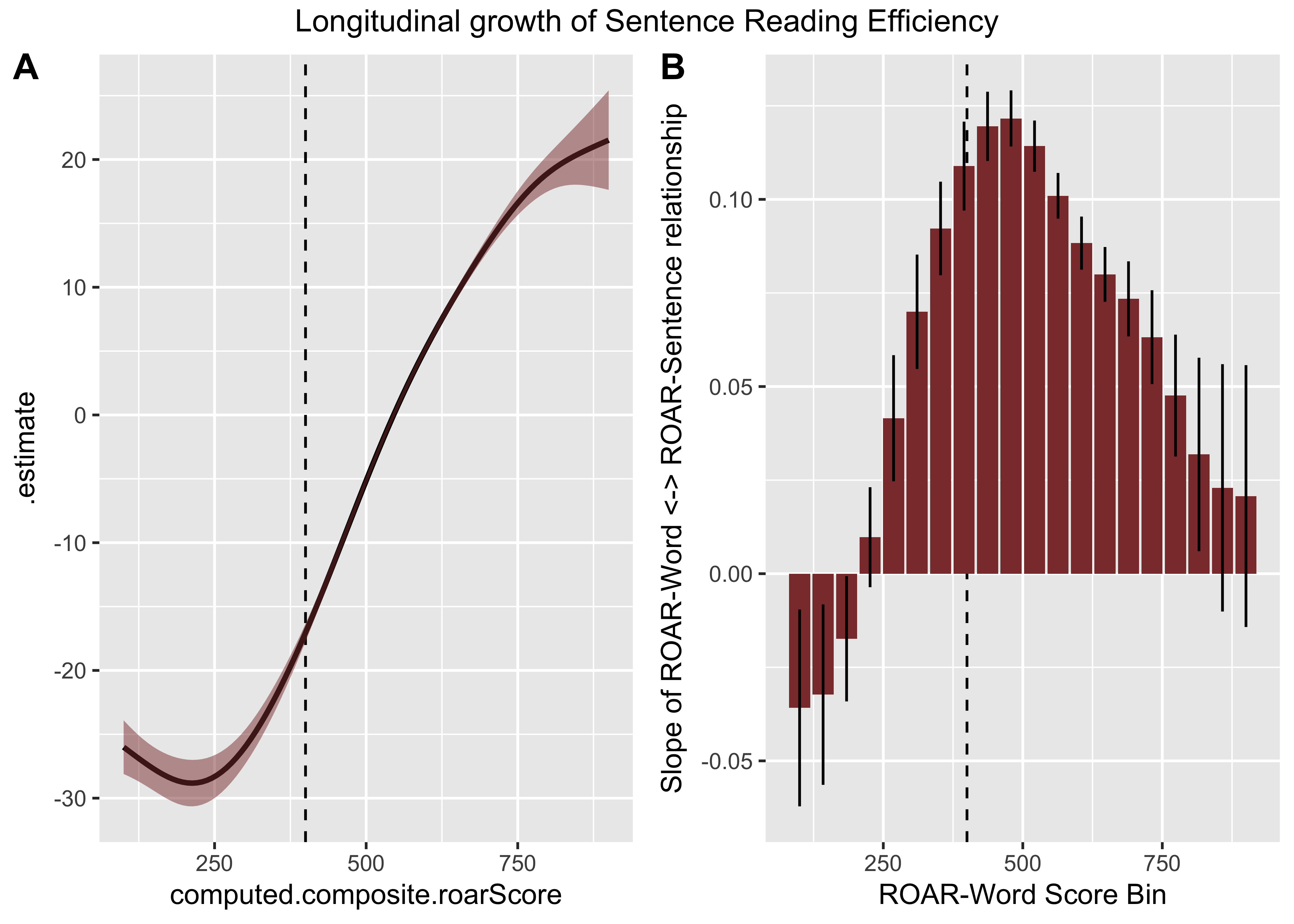
Fitting a longitudinal growth curve model to 5537 observations from 1552 students with at least 3 timepoints of data, we can see that growth rates are steeper for students above a decoding threshold. Figure 37.2 shows the same pattern as Figure 37.1: A steep relationship between single word reading and sentence reading efficiency above a certain threshold of word reading skills.
References
Wang, Zuowei, John Sabatini, Tenaha O’Reilly, and Jonathan Weeks. 2019. “Decoding and Reading Comprehension: A Test of the Decoding Threshold Hypothesis.” Journal of Educational Psychology 111 (3): 387–401.